|  Many people carve walking sticks for a hobby, but few do it for a living. By a long route, Keith Pickering has discovered that it is the career for him. Like many other boys, Keith had little idea what he would do when he grew up - after all, few school teachers suggest a career making sticks! All Keith knew was that he loved fishing. He fished at every opportunity. Many people carve walking sticks for a hobby, but few do it for a living. By a long route, Keith Pickering has discovered that it is the career for him. Like many other boys, Keith had little idea what he would do when he grew up - after all, few school teachers suggest a career making sticks! All Keith knew was that he loved fishing. He fished at every opportunity.
As a boy in Middlesbrough, he also enjoyed woodwork lessons. However, he was thought 'bright' and so was pressured to give up woodwork and take more academic subjects instead. After leaving school, he studied for a degree in Environmental Studies. Still not sure what he wanted to do, he saw a job offered on a trout farm near Helmsley. Liking fish, he thought this would do while he thought about what to do next.
As so often happens, the temporary became the permanent. Keith came to Helmsley and, just when he thought he might move to Scotland to work on a salmon farm, he met a girl working in a local stables. They married and Keith settled down to work at the trout farm and bring up a family.
During this time, Keith learned to shoot. It began as a way of controlling rats on the farm and progressed to pigeons and rabbits on local farms.
Through this shooting Keith got to know the local game keepers and became a beater for the pheasant shoot. He bought a Labrador to train as a gun dog. This precipitated the turning point in his career when his wife bought him a stick decorated with a labrador's head.
Keith thought his gift was wonderful but felt the challenge to make an even better one. Using a pocket knife, he had a go at carving the head of a cock pheasant. He didn't feel this was very good but had another go. The next one was better and he used it for beating at the shoot. Others saw it and asked if he'd make one for them.
Next season, he was 'promoted' from beater to loader. This meant that visitors saw much more of him and his sticks. He rapidly became known as the 'stick man' and requests to carve sticks came in thick and fast.
Keith saw that there was an opportunity here. He began his preparations: building his customer base, practising his skills, and visiting shows, to get his name more widely known. Eventually, in November 1999, he hired a workshop at Helmsley's walled garden and gave up the job at the trout farm.
Winter proved a busy time as people came to Helmsley to shoot and put in orders for personalised Christmas presents. Keith can carve a portrait of a favourite dog, from a photograph. These make popular gifts for special occasions.
He has also carved sticks with family crests on them. A particularly successful one, he says, was the crest of a raven holding a gold ring in its mouth. When painted, the gold showed well against the black.
Although Keith visits shows to demonstrate his work, he does not enter competitions. In a competition, he says, you have to please the judges. Keith's judges are the paying public, those who buy his sticks.
Keith also runs training workshops, teaching people to carve their own sticks. In a one day course, people can make a basic crook stick, with a handle of polished hardwood or deer antler. A carved animal head takes two days. These workshops run in the winter months. Participants get a double satisfaction; they take home a unique stick, and they made it themselves.
HAZEL
The sticks are hazel, cut by Keith in nearby woods. They have to be straightened, by heating the wood with a hot air gun. When sufficiently hot (taking care not to scorch the bark) the wood is pliable and can be straightened. A peg is cut at the top of the stick and inserted into a hole drilled in the hardwood handle. This is glued on, and is then ready to carve.
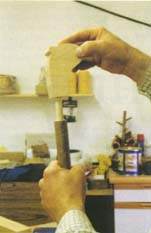 In the picture, Keith shows how the hardwood blank is fitted over the peg in the handle before carving the head. In the picture, Keith shows how the hardwood blank is fitted over the peg in the handle before carving the head.
Keith carves using a small, sharp knife and a set of small chisels and gouges given to him by his mother-in-law. He reciprocated by giving her a stick carved with a witch's head! It seems she was pleased; her grandchildren are entertained with stories of adventures on her broomstick. Now she has a personalised
wand to go with it.
Keith's animal head carvings are very lifelike. The eyes, he says, are the most important part, as these bring the face to life. He works carefully from one side of the head to the other to ensure that the features are balanced. When Keith first started he used to painstakingly measure, marking out the positions and proportions of the features. He worked from real animal heads, which he kept in his freezer. For years, he says, he kept a fox's head there.
Now, after 15 years' experience, he can carve freehand. He is very good at trout: after 19 years in fish farming, he says he knows exactly what a trout looks like!
After carving, the heads are painted in natural colours then varnished to protect them. The eyes are given a life-like, liquid shine with high gloss varnish. The sticks are left long, then cut to size and the ferrule fitted when purchased, to perfectly fit the owner.
Now that he has found what he wants to do, Keith is a contented man. He loves the countryside around his home in Helmsley, loves the animals, and the people he meets. His customers include royalty from all over Europe, and he now has sticks in the USA too; he is currently working on a big order for a store in New York. The 'Stick Man' has finally found the career that suits him.
Keith's workshop at Helmsley Walled Garden is open most days. He can be telephoned on 01439 771450.
|